How to Choose a Remote I/O Module Brand: A Guide to System Architecture and Communication Protocols
Choosing a remote I/O module involves evaluating system architecture, communication protocols, signal types, and installation conditions. This article references ULO GROUP, Siemens, Phoenix Contact, Weidmüller, Beckhoff, WAGO, B&R, and Turck, outlining key selection factors and ULO GROUP's remote I/O solutions.
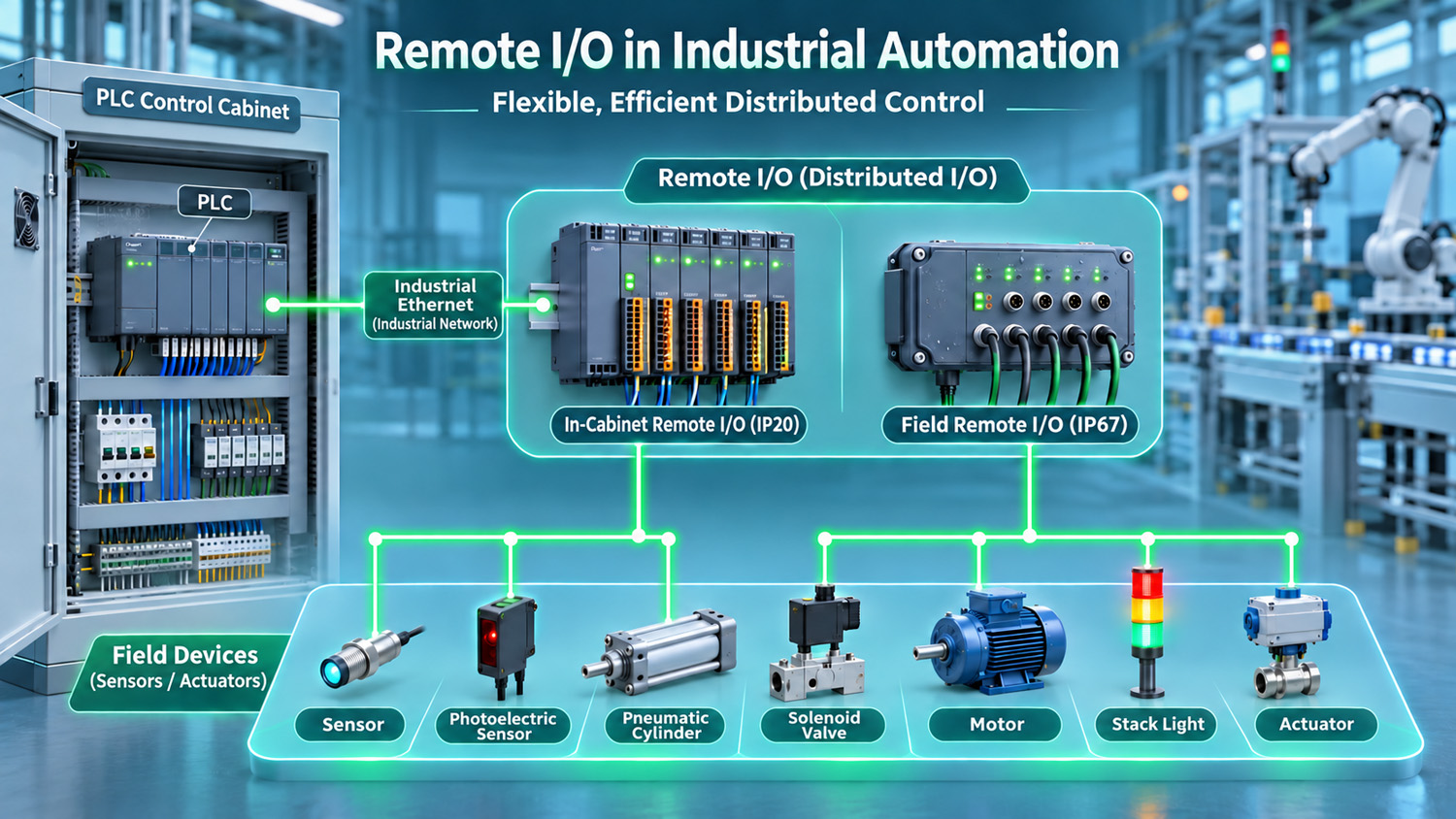
The Role of Remote I/O
Remote I/O modules collect field signals and control devices at locations away from the main controller, exchanging data with PLCs through industrial networks.
Unlike centralized I/O systems, distributed I/O allows multiple stations to be placed closer to field devices, helping reduce cable runs and improve installation flexibility.
System planning should also consider station locations, signal distribution, network topology, and power requirements to support installation, expansion, and maintenance.
Remote I/O Brands and Product Portfolios
Leading industrial automation brands include ULO GROUP, Siemens, Phoenix Contact, Weidmüller, Beckhoff, WAGO, B&R, and Turck, all offering I/O solutions for different applications.
Their products vary in architecture, module configurations, communication options, and engineering tools. Selection should focus on specific product series and models, including protocol compatibility, I/O types, channel capacity, installation methods, and technical support.
Key Selection Factors
Communication Protocols:Confirm the protocols supported by the PLC or controller and the network role of the I/O module. Common protocols include PROFINET, EtherCAT, EtherNet/IP, and Modbus TCP. Actual support depends on the specific model and firmware version.
Signal Types and Channels:Identify the required digital inputs, digital outputs, analog inputs, analog outputs, and special signals such as temperature. Check channel capacity, electrical specifications, analog ranges, and resolution.
Installation and Environment:IP20 I/O modules are generally designed for control cabinet installation, while IP67 modules can be deployed closer to field devices. Protection ratings, connectors, cables, and power requirements should also be considered.
ULO GROUP Remote I/O Solutions
ULO GROUP continues to expand its industrial communication and control portfolio, offering distributed and remote I/O solutions in IP20 and IP67 configurations.
Module selection can be tailored to equipment structure, signal distribution, and installation space. Communication compatibility should be verified against the PLC, target protocol, and network configuration.
For machine builders and system integrators, providing the PLC model, communication protocol, signal list, channel requirements, and installation conditions helps identify suitable modules. Technical reviews, sample testing, and small-batch trials further verify compatibility.
Choosing remote I/O requires more than selecting modules. It means matching system architecture with actual field requirements. ULO GROUP continues to develop flexible I/O and industrial communication solutions to support more efficient automation systems.
Through reliable industrial communication and flexible I/O architectures, ULO GROUP continues to advance industrial connectivity and control, making industrial connectivity simpler and automation more efficient.
— ULO GROUP