Why Can't Devices on the Same Switch Communicate with Each Other? Understanding Port Isolation
Devices connected to the same switch may still be unable to communicate directly, even when they belong to the same VLAN and IP subnet. Port isolation restricts direct communication between designated ports while allowing devices to access the uplink and gateway.
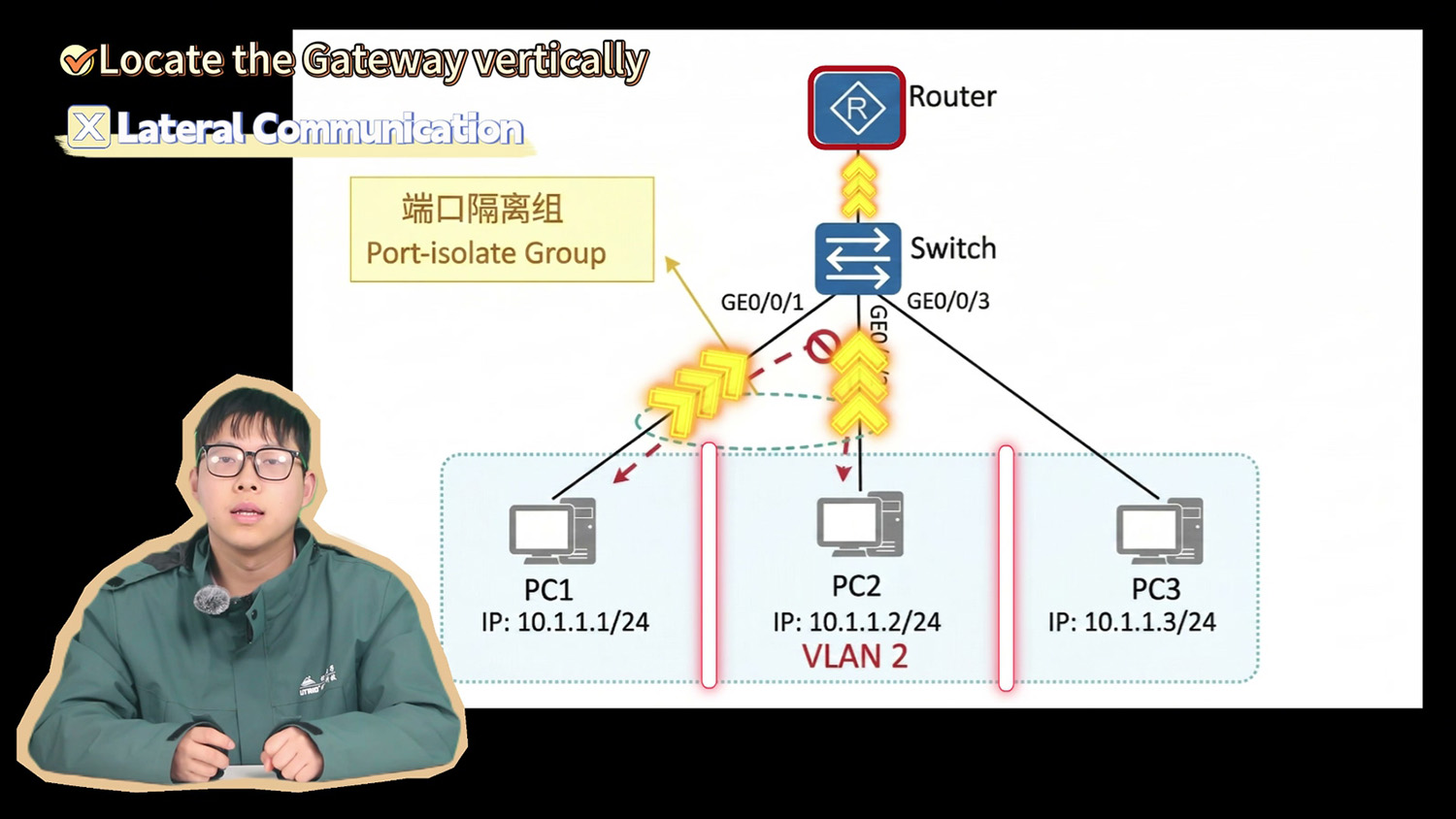
Same Network, No Direct Communication
Under normal network conditions, devices connected to the same switch and belonging to the same VLAN and IP subnet can generally communicate at Layer 2. However, when port isolation is enabled, ports assigned to the same port-isolation group cannot communicate directly with one another.
The network topology in the demonstration shows PC1, PC2, and PC3 connected to the same switch, all within VLAN 2. The ports connected to PC1 and PC2 are assigned to a port-isolation group. As a result, these devices cannot communicate directly at Layer 2, even though they belong to the same IP subnet.
Vertical Access, Horizontal Isolation
Port isolation restricts direct communication between designated switch ports, providing horizontal isolation between connected devices.
Devices connected to isolated ports can still access the switch uplink and gateway, but ports within the same isolation group cannot communicate directly with one another.
This approach limits unnecessary communication between devices while preserving access to essential network resources.
Typical Applications
Port isolation is suitable for network environments where direct communication between devices needs to be restricted:
- Surveillance Network Isolation: Restricts unnecessary direct communication between surveillance network endpoints.
- Guest Network Security: Limits direct access between different guest devices.
- Industrial Device Isolation: Restricts unnecessary communication between industrial devices to reduce unwanted interactions.
The purpose of port isolation is to restrict direct communication between designated ports, not to completely disconnect devices from the network. With appropriate port configuration, network access control can be improved while maintaining connectivity to the gateway.
ULO GROUP is committed to advancing industrial connectivity and communication solutions, helping customers build safer, more organized, and more reliable industrial networks with dependable Industrial Ethernet switching solutions.
— ULO GROUP