Why Is Analog Data Fluctuating? A Comparative Test of ULO's Analog I/O Module
During PLC commissioning, fluctuating analog values often lead engineers to suspect sensor or field-signal issues. To evaluate module performance, ULO GROUP compared different modules using the same signal source and monitored their acquisition curves through PLC software.
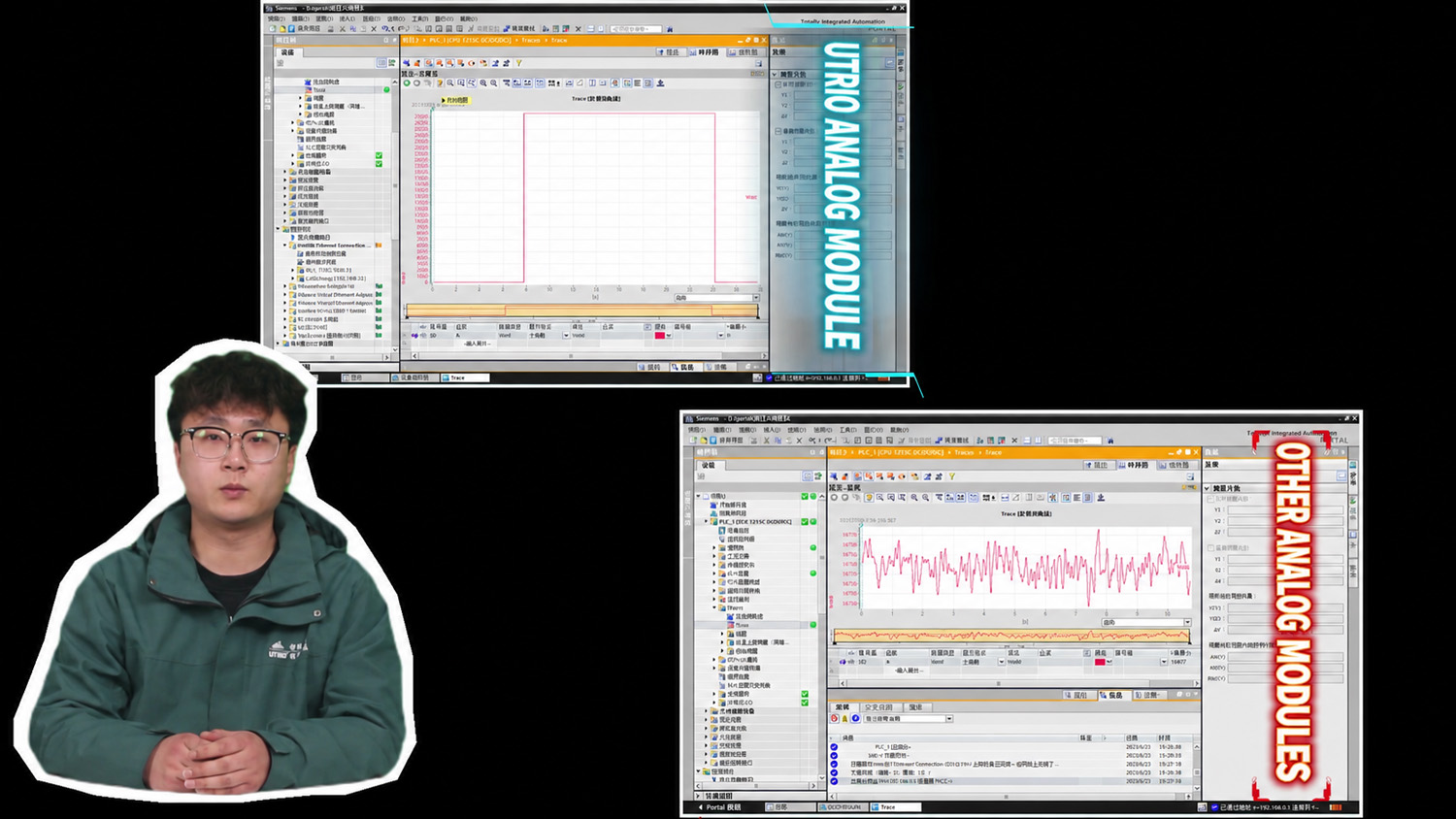
Comparative Testing with the Same Signal Source
In the video, a signal calibrator is used as the signal source and connected to both a Siemens analog I/O module and a ULO analog I/O module. The acquisition data from both modules is monitored in real time through PLC software, allowing their data variations to be compared under the same test conditions.
Visual Comparison of Acquisition Curves
The trend curves displayed in the PLC software show that the data acquisition curve of the ULO analog I/O module remains relatively stable, while the other module exhibits more noticeable fluctuations. This comparison demonstrates that analog signal fluctuations are not necessarily caused by field signals alone; the performance of the acquisition module itself also deserves attention.
Optimized Data Acquisition Performance
To address analog data acquisition challenges, ULO's analog I/O modules feature faster-refreshing analog acquisition chips and optimized sampling algorithms, improving data acquisition performance and providing support for PLC commissioning and industrial field signal acquisition.
From reliable acquisition of every field signal to continuous improvements in industrial automation connectivity, ULO GROUP remains committed to product innovation and technological advancement, delivering more reliable and flexible industrial connectivity and control solutions for customers.
— ULO GROUP