How to Integrate Remote I/O Modules with PLCs: Protocol Compatibility and System Configuration
Integrating remote I/O modules with PLCs requires protocol compatibility, device configuration, and accurate I/O data mapping. This article covers PROFINET, EtherCAT, EtherNet/IP, Modbus TCP, and IO-Link, highlighting ULO GROUP's remote I/O solutions and compatibility verification process.
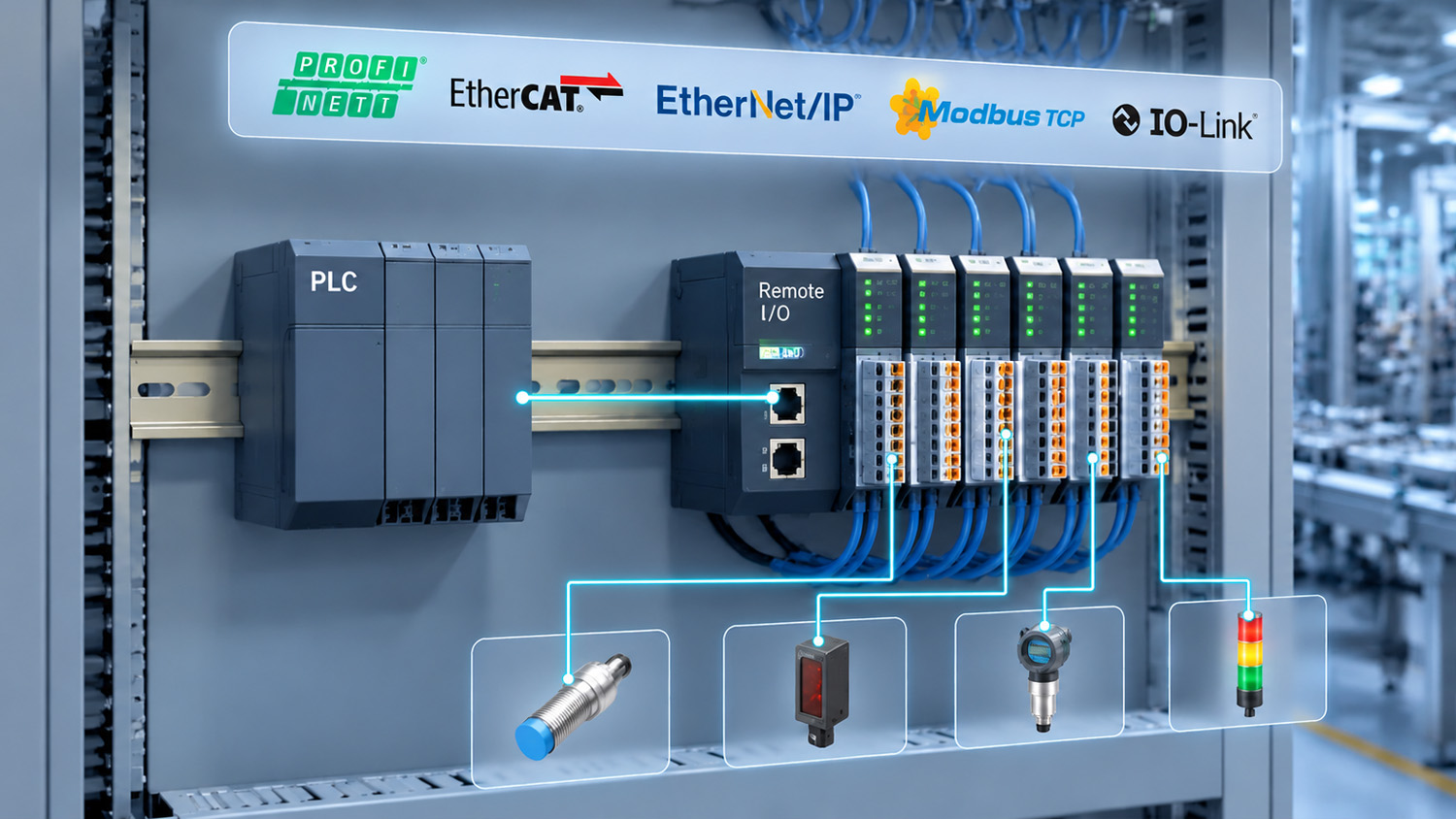
Protocols and Device Roles
Remote I/O modules typically connect to PLCs or controllers as network devices. Before integration, verify the PLC's supported protocols, device roles, module models, and firmware versions.
Common industrial protocols include PROFINET, EtherCAT, EtherNet/IP, and Modbus TCP. IO-Link connects IO-Link masters with field-level sensors and actuators, while the master exchanges data with the PLC.
Sharing the same protocol does not guarantee compatibility. Device roles, data lengths, diagnostics, and engineering software must also be checked. For new equipment, define the controller platform and network protocol early. For production line upgrades, first check the existing PLC, network architecture, and communication interfaces.
Device Description and Engineering Configuration
Different protocols use different device description files:
- PROFINET: GSDML device description files.
- EtherCAT: ESI device description files.
- EtherNet/IP: EDS device description files.
- IO-Link: IODD device description files.
- Modbus TCP: Register maps specifying addresses, function codes, data types, and byte order.
Device description files must match the product model and firmware version and are not interchangeable across protocols.
For Modbus TCP, verify communication roles, IP settings, port numbers, and register read/write operations to ensure correct data exchange between the PLC and connected devices.
Data Mapping and On-Site Commissioning
After configuration, check I/O byte lengths, channel sequences, data types, and status information.
For digital I/O modules, verify channel status, input filter time, and output behavior. For analog I/O modules, check signal ranges, resolution, engineering units, and data scaling to avoid incorrect readings.
Commissioning should cover device names, IP addresses, network topology, communication cycles, watchdog settings, and diagnostics. Single-station communication, I/O point, and communication-loss tests help verify system performance.
Keep records of PLC project versions, I/O module models, firmware versions, device description files, and I/O mapping tables for future maintenance and expansion.
Product Portfolio and Integration Support
In the industrial I/O market, ULO GROUP and international manufacturers such as Siemens, Phoenix Contact, Weidmüller, Beckhoff, and WAGO offer solutions for automation, machine building, and system integration.
Their products vary in protocols, module architectures, I/O configurations, expansion capabilities, diagnostics, and engineering tools. Selection should consider the PLC platform, field signals, and expansion needs.
ULO GROUP provides remote I/O, distributed I/O, and industrial communication products. For project evaluation, customers can provide PLC models, target protocols, I/O module models, signal lists, and data requirements.
ULO GROUP can then review protocol support, device description files, configuration parameters, and sample testing to verify compatibility.
Protocol support depends on the specific model and firmware. Laboratory or on-site testing is recommended before large-scale deployment to ensure reliable operation and future expansion.
ULO GROUP connects field devices with control systems through industrial connectivity and control solutions, enabling more efficient and flexible automation.
— ULO GROUP