How to Select IP67 Remote I/O Modules: Installation and Wiring Requirements
IP67 remote I/O modules bring signal acquisition and control closer to field devices, reducing wiring and improving flexibility. This article covers key selection factors, including I/O types, protocols, power supply, connectors, and operating environments, with reference to ULO GROUP's I/O portfolio.
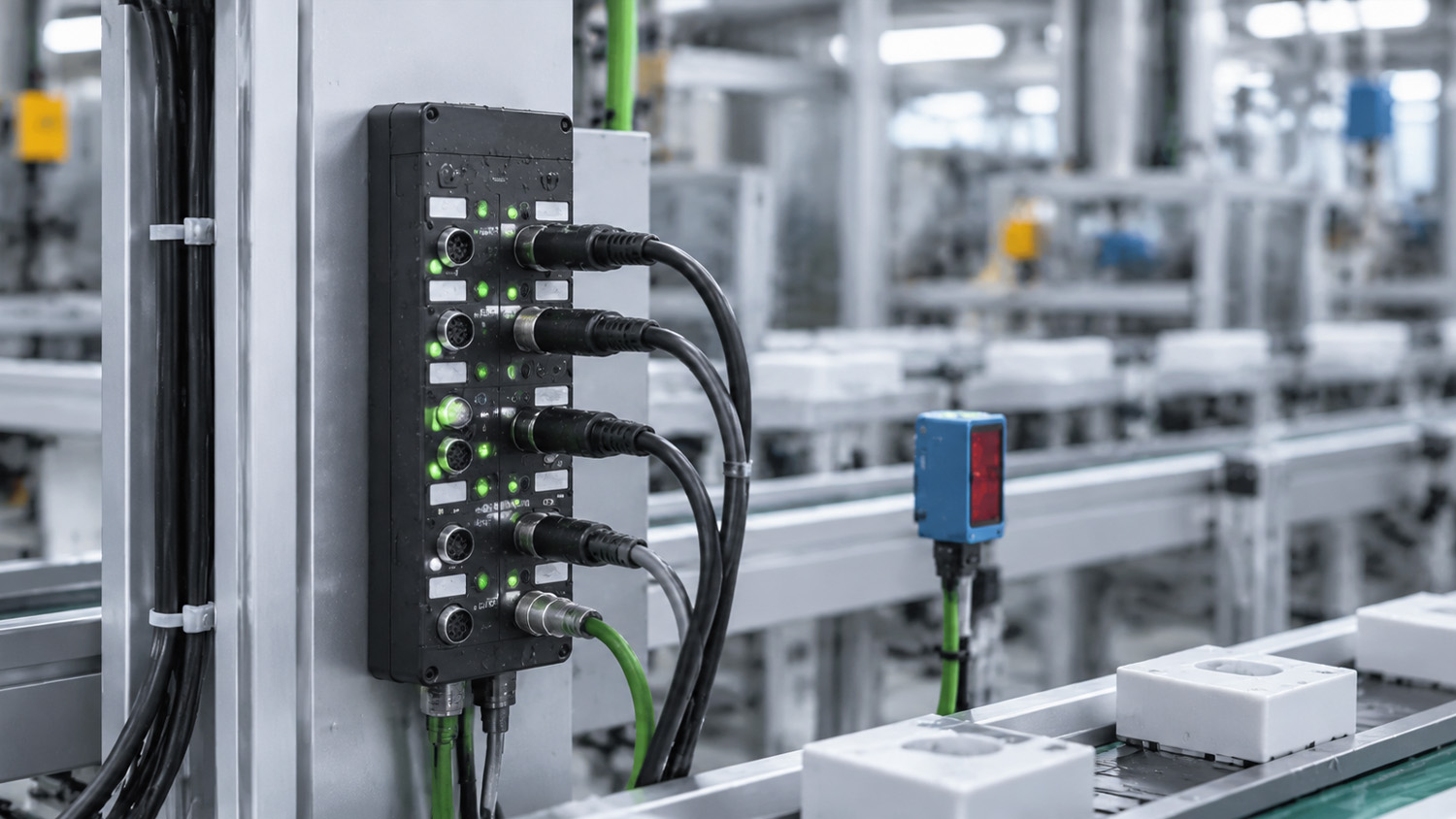
Field Installation
When sensors, actuators, and machine stations are distributed across different locations, routing all signals back to a central control cabinet can increase cable lengths and installation effort.
IP67 remote I/O modules can be installed close to field devices, collecting signals locally and communicating with the PLC or controller through an industrial network. This approach is suitable for conveyor systems, packaging equipment, modular machinery, and distributed workstations, helping simplify wiring and improve installation flexibility. The decision should also consider equipment design, maintenance requirements, and the overall control architecture.
Protection Requirements
IP67 indicates dust-tight protection and protection against temporary immersion under specified test conditions. However, it does not automatically mean that a product is suitable for high-pressure washing, prolonged immersion, or all chemically aggressive environments.
For applications involving oil, cleaning agents, salt spray, high temperatures, or continuous vibration, additional attention should be given to housing materials, sealing structures, operating temperature ranges, and connector suitability.
During installation, connectors must be properly mated and secured. Unused ports should be protected as specified, while cable fixing, mounting orientation, and sealing conditions should also be checked to maintain the intended protection level.
I/O and Interface Configuration
Selection begins with identifying the required digital inputs, digital outputs, analog inputs, and analog outputs. Input voltage, output current, analog ranges, and channel isolation should also be verified. For outputs driving solenoid valves, indicator lights, and other loads, both per-channel and total module load limits must be considered when planning power capacity.
For connections, verify circular connector specifications, pin assignments, coding, cable lengths, and protection requirements. Communication protocols must also be compatible with the control system. Power wiring, grounding, shielding, and network topology should be considered during system design.
In the industrial I/O market, ULO GROUP operates alongside established manufacturers such as Siemens, Phoenix Contact, Weidmüller, Beckhoff, WAGO, B&R, and Turck. These companies offer different product architectures, channel configurations, and communication capabilities. Specific product series and technical specifications should be reviewed when selecting a solution, particularly for IP67 applications requiring field-mounted installation and corresponding connection structures.
Application Evaluation
ULO GROUP's I/O portfolio covers both IP20 and IP67 product categories, supporting evaluation for different installation environments, equipment structures, and control requirements.
Before implementation, it is recommended to review the equipment list, I/O points, communication protocols, power supply, connector specifications, and installation locations. Sample wiring, network communication, load operation, and on-site protection tests can help verify application compatibility.
With additional product offerings including protocol converters, industrial Ethernet switches, and bus valve islands, ULO GROUP can also support broader considerations for field signal acquisition and equipment communication, helping customers develop more integrated distributed automation systems.
ULO GROUP continues to expand its industrial I/O portfolio, delivering flexible connectivity and control solutions that help build reliable and efficient distributed automation systems.
— ULO GROUP