RS-485 and IO-Link Both Support Communication. Why Are More Industrial Applications Choosing IO-Link?
Both RS-485 and IO-Link are widely used in industrial communication, but differ in connectivity and device management. RS-485 focuses on data transmission and requires wiring and baud rate configuration, while IO-Link supports intelligent device connectivity, status identification, and monitoring, offering greater flexibility in expansion and diagnostics.
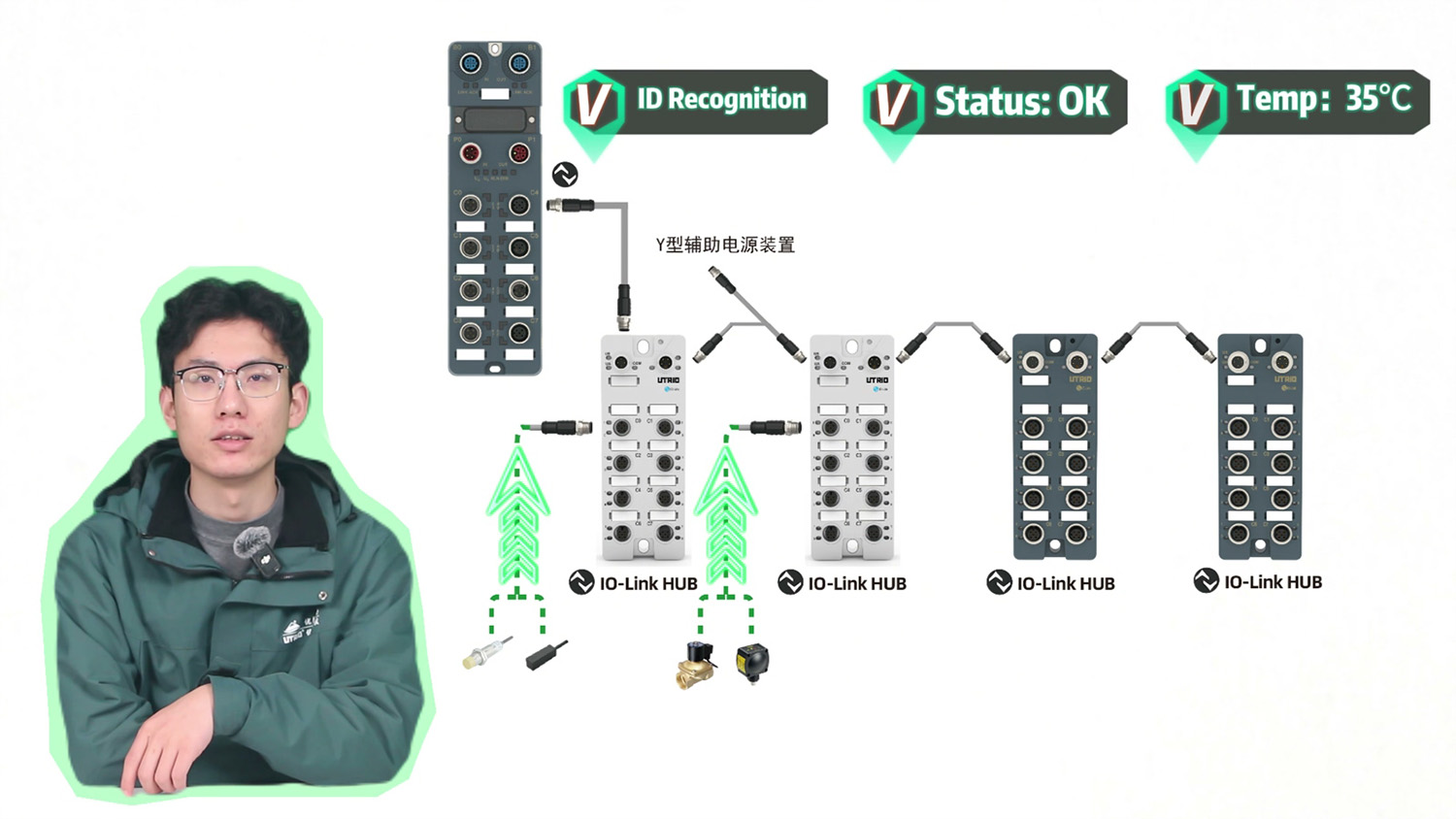
Connectivity: Bus Communication and Intelligent Expansion
RS-485 typically uses a bus topology to connect multiple devices through a shared communication line, enabling data exchange for conventional industrial applications.
IO-Link is designed for field devices such as sensors and actuators. With IO-Link masters and HUB expansion solutions, devices can be connected and exchange information through a more flexible connectivity architecture.
Functionality: Data Transmission and Device Management
RS-485 is primarily used for data transmission between devices and requires wiring and baud rate configuration.
Beyond data transmission, IO-Link supports device identification, operating status monitoring, and temperature readings. With IO-Link HUB expansion, device information becomes easier to access, while troubleshooting and diagnostics become more convenient.
How to Choose?
For applications requiring conventional device communication and data transmission, RS-485 can meet the relevant requirements. For applications involving intelligent device identification, status monitoring, and flexible device expansion, IO-Link offers additional advantages.
Industrial communication is not just about data exchange. Making device information more accessible and management more convenient is equally important. Choosing the appropriate communication technology helps improve the operation and maintenance efficiency of industrial automation systems.
ULO GROUP continues to advance industrial communication and connectivity technologies, delivering flexible and reliable solutions that simplify field device connectivity and make industrial automation more efficient.
— ULO GROUP